If you have actually ever before renewed your CPR card and walked out thinking, "I forgot just how much I would certainly lost," you're not alone. Ability fade is genuine. I see it when I evaluate students who last skilled 2 years prior. Their hands be reluctant on the sternum, their series blurs, and the AED pads get peeled back up to examine placement. Excellent intent remains, but the muscular tissue memory has thinned. A CPR correspondence course bridges that void and, much more importantly, updates your approach to match existing proof. Procedures change in silent but significant methods, and those changes can be the difference in between a pulse returning and a scene waiting helplessly for paramedics.
The clock on your certificate and what it really means
Most CPR certificates end every two years. That time framework isn't approximate. Research studies in resuscitation scientific research continually reveal that sensible skills begin to decrease within 3 to 6 months, especially compression depth and price, correct air flow quantities, and team sychronisation. Two years is the outer limit most certifying bodies will certainly approve before they require you to show skills once again. If you're holding a first aid certificate first aid and cpr course Gympie that consists of basic life assistance, you'll commonly see the same two-year cycle, though some healthcare companies prefer annual updates, particularly for team that seldom do resuscitation.
The expiration day matters in two means. First, for compliance. Employers, licensing companies, and professional boards such as those supervising child care, physical fitness direction, or aged treatment, generally require present proof of training. Second, for realism. If your last exposure to a manikin was twenty months ago and your last real emergency situation was never ever, your speed, self-confidence, and precision will not be what they should be. A CPR refresher course is the sanctioned means to re-sharpen your abilities and align with updated guidance.
When must you restore, practically speaking
Aim to renew your CPR course well before your certificate gaps. A safe home window is at the 18 to 21 month mark if you're on a two-year cycle. If your duty includes risky environments, direct treatment, or a first -responder feature, think about yearly CPR training. Many workplaces run their first aid courses and cpr courses on a foreseeable routine. Book on your own early. I've seen excellent team benched from changes or not able to begin brand-new roles because their cpr training slipped a week past expiry.
Certain trigger events should also motivate an early refresher. If your organisation has transformed AED designs across facilities, take the course that consists of hands-on familiarisation. If you have actually relocated from grown-up care to paediatrics, switch over to a first aid and cpr course that allots time to infant compressions and air flows. After a challenging real-world resuscitation, the most effective specialists debrief, read, and seek a refresher to validate or correct what they did under pressure.
Why guidelines change and why that matters
CPR appears easy from the exterior: push, take a breath, shock if required. Inside that simpleness rests a mass of detail that shifts as study accumulates. A couple of instances show the speed and value:
- Compression-first emphasis. The proportion and series for lay rescuers has actually prioritized compressions, with less disruptions and less complex entry right into activity. Also the language around "check for breathing" has advanced to discourage time-wasting micromanagement. Minimal disruption. The variety of secs you enable pulse checks, air flow transitions, and rhythm analysis has actually ratcheted down. Energy saves lives. Exact stops briefly come to be a learned habit you fine-tune in a refresher. AED triggers and pad positioning. Producers upgrade firmware, voice prompts, and electrode adhesives. Some models approve adult pads for older kids in a pinch, others advise pediatric setups differently. If you trained on one box and currently work close to another, a refresher course prevents surprised appearances throughout a real arrest.
Every upgrade rests on research studies that determine survival, neurological results, and scene effectiveness. The refresher course course curates the signal from the sound and lets you practice the modifications up until they really feel natural.
What a solid CPR refresher course ought to cover
A well-constructed cpr correspondence course is not a slog with slides. It puts you at the manikin, offers you sensible situations, and trainers you with restorative comments. When I instruct, I seek 4 outcomes: consistent high-grade compressions, proper air flows, correct AED usage, and sound judgment concerning when to begin, stop, and stop. The material to arrive normally consists of:
- Compressions, with real-time responses where readily available. Anticipate to pursue 5 to 6 cm depth for adults, a full breast recoil, and a price in the 100 to 120 array. If the venue has a comments manikin, you'll listen to distinct coaching or see a control panel. Utilize it. It tightens your kind within minutes. Ventilations. Numerous learners either under-ventilate or provide a huge gust that distends the stomach, not the lungs. Modern courses teach smaller volumes with visible chest surge, coupled to marginal compression downtime. Face guards and pocket masks are not simply props. If your work environment uses bag-valve masks, you must manage them a minimum of briefly under supervision. AED application. The tidy sequence is power on, pads on bare upper body, comply with motivates. We pierce pad positioning around implanted tools, transdermal patches, dampness on the breast, and body hair. You must also practice handing off duties securely during evaluation and shock distribution. AED choreography matters in jampacked rooms. Special populaces. Babies, kids, and expecting individuals call for dedicated minutes. Deepness, hand placement, and air flow proportions differ. A few representatives below secure electric motor memory you can call on without panic. Scene leadership. Also if you are not a team leader at work, life will sometimes cast you because function by crash. A great course techniques closed-loop communication ("You, call three-way zero," "AED is on, charging," "Switching compressors at 2 mins"), turning timing, and space management around the patient.
If you're scheduling an integrated first aid and cpr course, the day will also consist of bleeding control, choking alleviation, shock, burns, anaphylaxis, and diabetes mellitus emergency situations. That more comprehensive first aid training offers you a much more total device kit. Numerous suppliers, consisting of First Aid Pro and comparable organisations, run first aid courses with modular alternatives so you can refresh just CPR or add the rest if your first aid certificate is likewise due.
How typically do genuine skills fade
I have actually enjoyed qualified individuals shed fine points within months. Compression depth drifts shallow first. Then hand positioning sneaks off-center. The following casualty is timing. Breaths extend from one second to two, or voids between cycles lengthen. If you have actually found out CPR just once and never ever touched a manikin again, the slide is faster. Those that practise quarterly or semiannually keep their edge. Two experiences attract attention from my own training:
- A lifeguard team pierced monthly on a cheap feedback manikin. When a heart attack struck their pool deck, they relocated like they would certainly rehearsed it the day in the past. Due to the fact that they had. They attained ROSC prior to EMS arrived. A workplace first aid team restored after two peaceful years. The difference between their preliminary sets of compressions and their collections after twenty mins of coaching was all the time. You might hear it in the tempo and see it on the comments display: from 30 percent to 85 percent within the session.
These stories are common. They also explain why a brief re-training, even of 2 to four hours, pays outsize dividends.
How to choose the appropriate carrier and format
Not every program is built the very same. Select an attire that puts your hands on the breast, not your eyes on slides. Ask straight concerns before signing up: How much of the https://privatebin.net/?9144b702c2c12098#5SPkNuXdNfxc5VR3UHHQisYXV8r3km4fNSZ4tii5sYJ9 moment is sensible? Do you make use of manikins with comments? Will I reach practice with an AED that matches what we contend work? If you're responsible for a team, push for scenario-based drills. A trainer that watches, remedies, and repeats with you will certainly provide you better outcomes than one that talks and hands you a certificate.
Formats vary. Lots of companies provide mixed learning, with online concept followed by a much shorter in-person useful. For CPR refresher courses, that version works well if the skills session is long enough to reset practices. Fully online CPR accreditations might tick a conformity box someplace, however they do not establish physical skill, so check what your company accepts. If you bring a first aid certificate that needs revival together with CPR, a first aid and cpr course that integrates both can be efficient, supplied it preserves generous time for CPR practice.
Local service providers such as First Aid Pro and comparable organisations usually run daily sessions and can customize on-site training for work environments. If you book for a team, request debrief time at the end. Groups that talk about what worked out and what to change develop enduring habits.
What to anticipate on the day
A crisp refresher course stays concentrated. You'll sign in, reveal your existing or ran out card, and run through a quick theory review to align terminology. Then you'll invest most of the time practicing. In my classes, people rotate through terminals: compressions-only, compressions with breaths, AED application, and unique populaces. We change functions often so no one stands idle for lengthy stretches. We also place a couple of brief circumstances that require decision-making: the less competent child in a bathroom, the adult collapse in a health club where the AED is upstairs, the lone rescuer in a park with a phone but no bystanders.
Expect to sweat a little. Ten straight mins of compressions at the proper deepness and rate is an exercise. If you end up without an increased heart price, you possibly did not press tough or fast enough. That honest physicality is part of the point. Real apprehensions are messy. Your training should be durable sufficient to stand up under stress.
Paediatric and infant CPR, without fear
Parents and carers often confess they stay clear of baby CPR due to the fact that they hesitate of "damaging something." The course ahead is hands-on time. In a baby scenario, the heel of the hand ends up being 2 fingers at the breast bone for a single rescuer, or 2 thumbs with hands encircling the upper body if there are two rescuers. The deepness standard converts to approximately one third of the upper body's front-to-back dimension. Breaths must be gentler, just enough to see a rise. When you do this five or six rounds on an infant manikin under watchful training, the concern subsides and obtains replaced by measured technique.
Children sit in between grown-up and infant approaches. Compressions utilize one or two hands relying on the size of the child and the rescuer. Proportions for compressions to breaths may differ, particularly for doctor, which is why reading your course product ahead of time aids. An excellent refresher course lets you make these transitions smoothly without mental gymnastics.

AEDs are smarter, you still require to think
Modern AEDs evaluate rhythms accurately and guide your steps with clear prompts. That does not absolve you of judgment. In course, we practice continuity of compressions during AED configuration, secure clearing up of the person prior to analysis and shock, and quick resumption promptly after. We also manage truths like sweat on a fitness center flooring, steel jewellery, medication spots, and implanted devices. If you do not practice these in a controlled setup, you will discover them at the worst time.
AED placement patterns vary a little with version and patient anatomy. Criterion adult pads go top right upper body and reduced left side chest. If the client has a noticeable pacemaker lump under the skin, you change so the pad does not rest straight over it. For infants and toddlers when pediatric pads are not offered, some devices sustain anterior-posterior positioning to decrease pad overlap. This deserves 5 mins of your refresher, not a hurried hunch in the field.
CPR in the work environment, in your home, and in public spaces
The environment forms your strategy. In work environments with designated first aid police officers, the system typically relies on clear roles. One person leads compressions, one takes care of the AED, an additional regulates the space and guides EMS to the scene. Rehearsing those roles throughout your first aid and cpr courses seals them. In the house, you might be alone. Part of your refresher should address lone-rescuer methods: speaker phone with send off, quick landmarking for compressions, and a prepare for fetching an AED if one is within a sprint.
Public areas add group administration. I educate students to use their voice early and particularly. Rather than shouting "Help," point to an individual in the crowd and say, "You in heaven jacket, call three-way no and bring me the AED from the entrance hall." Even if you never ever lead at work, you might need to lead next to a shopfront someday. Practicing that assertive quality in class settles when the adrenaline hits.
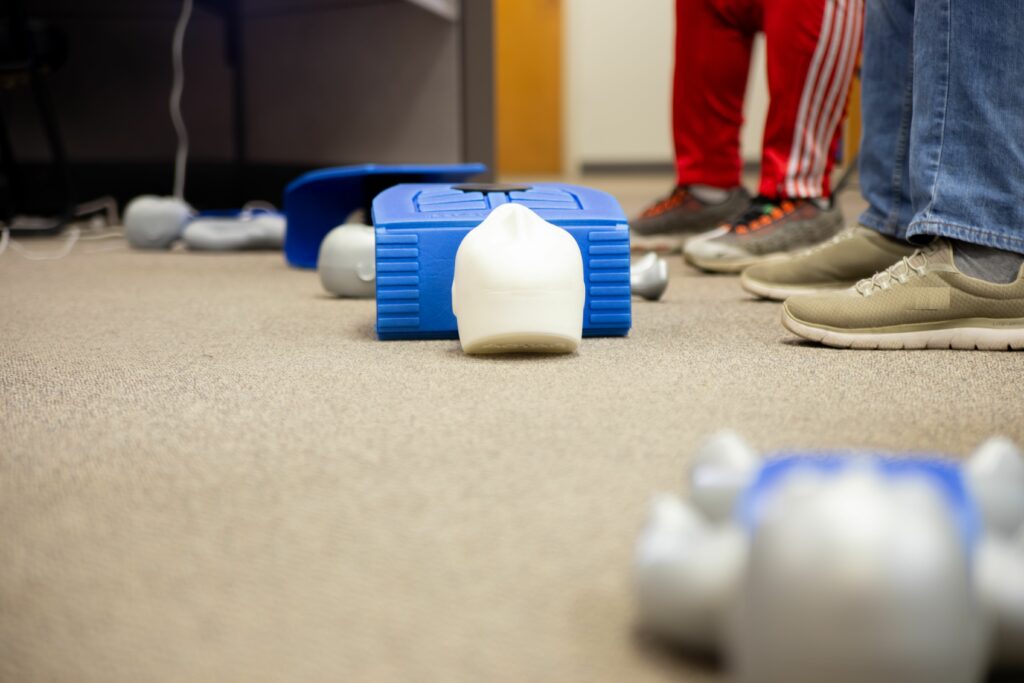
Common challenges the refresher irons out
I keep a short psychological listing of mistakes I try to find in seasoned individuals who have not trained lately. If a cpr refresher course is doing its job, you'll fix these in the very first hour:
- Hovering over the breast instead of full recoil. Squeezing down hard without allowing the upper body bounce back reduces coronary perfusion. The distinction really feels refined till a comments manikin shows your release percentage. Over-ventilating. Large breaths press air right into the stomach, not the lungs, and risk regurgitation. A smaller sized, one-second breath with visible breast rise is the goal. Losing matter or stopping also long. Great groups maintain time with the AED or a metronome, revolve compressors every two mins, and minimize dead time. Practising this rhythm brings back the groove quickly. Pad complication. Individuals put pads also close with each other on broad upper bodies or also low on the lateral side. Practice stays clear of the peel-and-restick dancing that wastes valuable seconds. Unclear management. Two or 3 individuals speak at the same time, no person owns the sequence, and compressions stall. Closed-loop interaction solutions this. A good instructor designs it and motivates you till it sticks.
These correctable concerns are why also proficient rescuers gain from refreshers. Lots of have superb impulses, they simply require a brief reset to line those reactions up with current best practice.
Legal and compliance factors to consider you must not ignore
For several functions, keeping an existing first aid certificate and CPR proficiency is more than best practice, it is an office demand. Companies and industry bodies normally name appropriate programs and renewal periods in policy documents. Some specify training course codes or recognized companies. If you remain in childcare, education and learning, health and fitness, safety, or aged treatment, examine your market's requirements. Health care functions usually call for greater degrees of life assistance training and even more constant refreshers.

Documentation matters. Keep electronic and paper copies of your certificates, with expiry dates noticeable. If you educate through an organisation like First Aid Pro or a similar provider, you will certainly get a dated certificate or pocketbook card. Store a duplicate in whatever human resources portal your workplace utilizes and a second duplicate in your phone. When audits come, the people who sail via are those who can create proof instantly.
How a refresher course incorporates with wider first aid training
A slim CPR-only class does one task well, but emergencies rarely restrict themselves nicely. Numerous apprehension circumstances are come before by choking, serious bleeding, or anaphylaxis. Folding CPR into a fuller first aid course once every cycle strengthens your capability to review what is in front of you. For example, an allergic reaction spiraling into respiratory arrest demands adrenaline administration and respiratory tract assistance prior to compressions start. A first aid and cpr course provides you the confidence to make that telephone call. If budget or time is tight, alternating years, with CPR refresher courses annually and a more extensive first aid training on the second year, works for lots of teams.
Preparing before you walk right into class
You do not require to pack, yet 5 or ten minutes of preparation enhances your session. Skim the most recent quick-reference overview from your provider. See a trustworthy two-minute video on hand positioning and rate. If you have a clever watch with a metronome, set it to 110 beats per minute and practice compressions on a firm pillow for a minute. It will certainly not change a manikin, but it advises your wrists what that pace really feels like.
Dress for work, not a photo. You will stoop, lean, and sweat. If you have knee concerns, bring a padding. Hydrate. Inform your instructor if you have injuries that restrict your activity, so they can adapt drills. Ease of access belongs to excellent training.
After course, maintain your side without overthinking it
Skill retention enhances with light, regular practice. Establish a schedule reminder every two or 3 months. Spend 5 mins with a coworker or member of the family walking through the sequence verbally, or practise compressions on a manikin if your office keeps one. Refresh your AED experience by opening up the case and evaluating the pads and motivates, with consent. In team setups, run a micro-drill after a team conference. Individuals grumble the very first time, after that thanks the day something happens.
Several service providers provide quick e-learning refreshers that take 10 to 20 mins. Utilize them between official renewals. They do not replace hands-on training, yet first aid course in bundaberg they maintain your head in the game.
What it feels like when training pays off
A few years back, a dining establishment supervisor who had actually dragged his feet on training got a CPR refresher course because his place changed to a different AED model. Two weeks later on, a patron fell down throughout lunch. The supervisor heard the agonal gasps, began compressions, and delegated the AED access with the very same phrasing he had rehearsed. The device advised a shock, he cleared the space, provided it, and went straight back to compressions. By the time the rescue staff took control of, the patron had a rhythm they might deal with. The manager later stated the essential difference was not knowledge however fluency. He did not need to choose each step. His hands recognized. That is what an excellent refresher offers you: less decisions, even more doing, done right.
Cost, time, and the value calculation
Most CPR refreshers run between two and 4 hours and are valued modestly contrasted to broader first aid courses. If your company funds training, accept it gratefully and schedule early. If you are paying out of pocket, take into consideration the estimation. You invest a morning and a small fee to have a useful ability that, if used once in 10 years, will be the most vital thing you bring to that moment. The expected-value argument is obvious. What maintains individuals away is usually inertia, not reasoning. Book it, show up, and allow the technique do the rest.
Final checks prior to your following revival date
Use this brief checklist to remain on top of your CPR status without last-minute shuffles:
- Note your CPR and first aid certificate expiry dates in your calendar with tips at 90 and 30 days. Confirm your work environment's required course degree and accepted service providers, including whether blended layouts are allowed. If your website has actually changed AED designs or locations, schedule a quick familiarisation session. Plan for paediatric content if your function involves kids, or for innovative web content if you utilize bag-valve masks at work. After your refresher course, log your certification promptly in your HR or compliance system and keep a duplicate on your phone.
Strong CPR is a perishable ability. A normal cpr correspondence course protects it, updates what you know, and offers you the calm to act under anxiety. Pick a service provider that prioritises hands-on practice, fold CPR into wider first aid training when you can, and keep easy routines that keep your edge. Whether you bring a first aid certificate for work or to be prepared for your family, renewal is not just about compliance. It has to do with being the person in the area who can transform a bad day around.